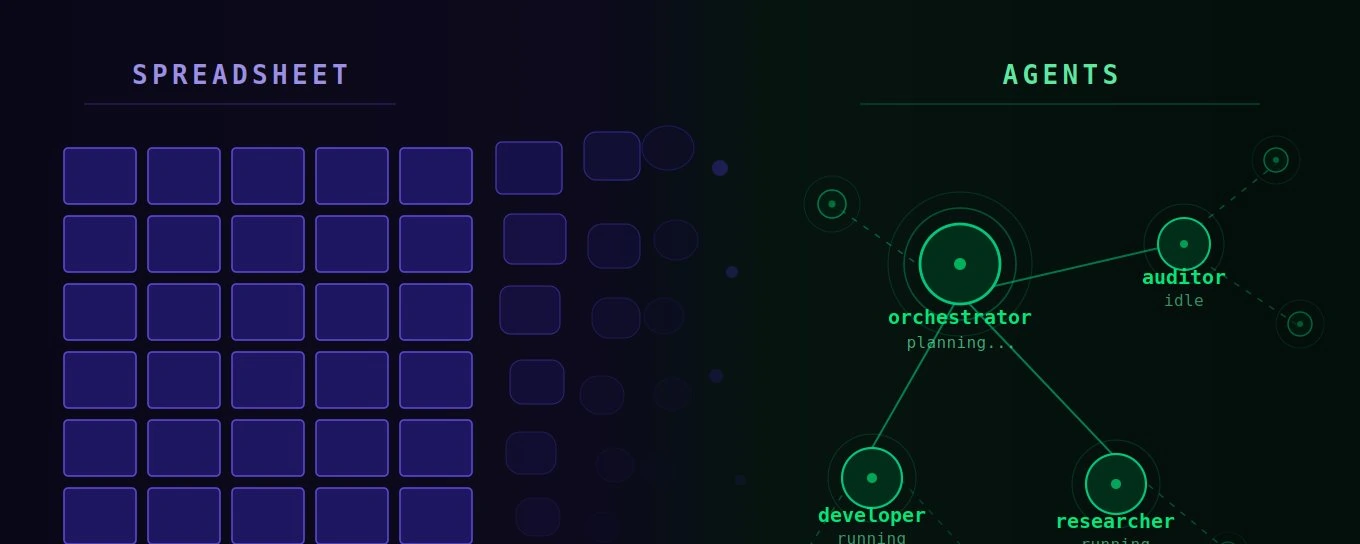
Intersect of LLMs and spreadsheet in the 80s
We have entered a 2-3 year transitionary window in December 2025. LLMs are now over the level where they replace developers for certain tasks, and to capture this window the most valuable skill shifted to flexible generalists, who are able to use the tool in any domain with outstanding results.
This is what happened with spreadsheets in the 80s, for 3-5 years anyone who was able to manage the tool was more valuable than domain experts. This is happening right now for software.
Incorrect inversion - What doesn’t work?
There is a clear drive currently to make organizations AI-native. The changes are happening, but the approach is currently fragmented and unclear.
Most organizations already started an AI push in 2025, and they are caught in a double bind. They need to right-size BUT they also need to find the right people to build out their internal AI-native capabilities. You are cutting costs while you are investing in something new in parallel. Getting this wrong will result in cuts that are too deep or in hiring tool experts while the structure is not ready to use them.
There is no gold standard checklist. But this is what I would start with:
Do you have clear feedback loops for agents to iterate against? Is your codebase testable enough to gate correctness automatically? Do you have enough bandwidth with your domain experts to review agent output to actually move quickly? If the answer is no, the foundation needs fixes first before moving to multiplication.
There is one clear sign I am seeing, do not throw tokens at the problem. If your approach is directly tied to it, the answer to the previous question is a resounding no.
Future flow - What works?
You are going to have domain experts working side-by-side with tool experts, running a swarm of agents producing multiple potentially breakthrough ideas per week. Domain experts are still critical to validate the output AND build the tools to automate it. Tool experts are critical because they are the people who are really not afraid to break things. And agents are just a tool, when used correctly they can produce 10 ideas in 1-2 weeks. If 10% is valuable you are already increasing shipping speed. zk-autoresearch currently sits at 66%.
If you invert correctly the methodology is the actual way to 10x productivity.
$1800 budget - 2 months - 2x production zk infra throughput
I have targeted leanVM (Lean Ethereum’s zkVM) for the past two months. My methodology has dropped the end-to-end latency by 2x. All of this happened by creating a custom automated research methodology and following these key principles.
Why cryptography?
The field has key characteristics from multiple angles that suit autoresearcher agents to deliver results.
-
Proofs are ideal for gate and correctness at the current state, the method is the proof itself that the work has been done correctly. The ground truth always has to be a real-life truth and ZK is a useful technique.
-
The impact is also easy to measure by throughput, e.g. e2e latency, which makes it easy for agents to interpret.
-
The talent pool was my last factor, globally the supply of engineers and cryptographers who are making contributions is narrow, the impact of using autoresearcher is high.
The setup:
-
minimalist agent harness -> Start small, validate, expand. Keep costs down instead of spending your way to results. Everyone can do the latter, few can do the former.
-
constantly increase depth of understanding -> don’t defer to experts, don’t delegate to agents. Become opinionated and develop taste
-
Keep it stupid simple -> Less is more, especially in RL scaffolding. Agents need direction not implementation specs and CRUD.
-
Slow down to speed up -> Take a step back, plan evaluate. Write the program.md manually, don’t over-rely on agents.
What we got:
-
Clean optimizations, missed angles -> clear low hanging fruits | 11.2%
-
Opinionated alloc reduction, applying working designs for agents from Jolt | 16.3%
-
New memory management with a zk focused allocator, built from scratch | 27%
Note: These compound from 100% baseline to 55% target. Estimated 1.9x
Every step of the way drove the next step. The depth was carefully built. What Sakana is trying to solve with RL + LLMs is applicable today by replacing the RL with humans.
Total cost of compute: $1200
Total cost of servers: $600
The recipe is classic product development, just inverted to an internal product. Evaluate readiness, bring in the right people, constrain, iterate and when ready scale it organization-wide.